James E Mack

Author of Military Thrillers and Spy Fiction

No country for old (or young) women?

Like many a soldier and then later in my career, an advisor, I spent a lot of time in Afghanistan. Years in fact. I count myself fortunate to have seen a lot of the country and not just the usual circuits of Kandahar and Helmand Provinces where the majority of UK Armed Forces conduct their operational tours. Logar, Herat, Nangarhar, Balkh, Paktia, Paktika, Kunar, Wardak, Parwan, Kabul were some of the regions I travelled and worked among others.

But there was one thing that I couldn’t help but observe on my travels: This was one harsh country. In every way; geographical, political, economical. A feudal landscape still dominated and ruled through tribal fiefdoms and powerful warlords. Travel an hour in any direction away from the capital of Kabul and the impact of Government was absolutely minimal if at all. A patriarchal patchwork of tribal allegiances and ethnic divides where the rule of law was determined at the local level by elders and men of influence. Patriarchal and male. Country-wide, this is how Afghanistan is really controlled.

Which leaves women with a very shitty deal really. On our first operational tours, even us older, worldly-wise individuals could be surprised at the level of the mistreatment of women in Afghanistan. Coming from a society where gender equality is a given and any mistreatment of a woman regarded as a particularly vile crime, some of the things we witnessed were particularly hard to take.

Again, far from the ivory towers of the Kabul government and their proud, vocal assertions that the foreign money and investment was improving the lot of Afghan women, the ground truth was very different. The medics on our patrols would regularly encounter village women hideously disfigured with scar tissue. Due to the patriarchal protocols our male medics were not allowed to treat these women but could only ask about the nature of the injuries in general and leave some medication with them. These injuries were a result of self-immolation; setting oneself on fire. I was to learn later that in a lot of these isolated villages, with very little else at their disposal, dousing themselves in the kerosene used for cooking and heating was a common way for a woman to attempt to kill herself.

The very nature of that type of suicide attempt pretty much underlines what a miserable existence someone must be experiencing to even consider such an act. On one occasion we learned that the woman we were trying to help had been bought and wed to a much older man, and I’m talking decades older here. She had suffered beatings from his other, older wives, given all the chores to carry out, and was being blamed for the chronic illness he was suffering. She had tried to escape back to her family but had been caught and again, brutally beaten for her transgression. Isolated, abused and unsupported she set herself on fire but did not die and was left in horrific agony with no medical treatment or medication to help.

These incidents were always reported back and initiatives and projects were developed to attempt to improve the situation. The setting up of Female Engagement Teams or FETs as they were called, was one such initiative. Female soldiers, translators, medics and civilian specialist advisors would deploy into the regions to engage directly with the local female populace. It was felt that this would be a good work-around the patriarchal limitations that our predominately male-composed patrols had been facing.

The good news stories soon began filtering back, initially in the formal reports and then onto the pages of each country’s military publications and websites. Smiling FETs with arms around village women, photos of a midwifery presentation being delivered in a crumbling concrete shed, footage of gender empowerment talks given to local women. The FETs were a solid program with great aims and focussed individuals motivated by the best of reasons. But they were fighting an uphill battle.

Although I have many examples, I think the one provided to me by a Dutch colleague gives a good general snapshot of how the program was received by the men in these regions. Anna was the lead on a coalition Female Engagement program that was reaching out to women in the isolated mountain villages and hamlets with a view to identifying their needs and addressing these requirements. Anna travelled everywhere with a complement of Dutch Marines for the protection of her team and allow them to carry out their meetings and work without the additional responsibility of looking after their own security. Anna and her team were usually accepted on a sliding scale of grudgingly to indifferent by the village elders. As for the women, it would take a little time for Anna and her team to convince them that they were there solely with the women’s interest at heart.

Anna loved her job, you can still tell that today by the enthusiasm and passion evident in her voice when she speaks about it. For her, to see and hear first hand how these women suffered fuelled her motivation to provide some improvement, no matter how small, to help them. Medical help, encouragement in self-assertion, offers to provide transport to allow them to attend clinics in nearby areas, provision of hygiene products; just some of the small but important initiatives Anna and her team provided to the women living among these remote, bleak mountain ridges.

To this day Anna is still unsure how the villagers managed to isolate her from her Marine security force. What she does remember is turning towards the door of the small room where she and her interpreter had been delivering a class in how to access further treatment. The door was wide open and the men from the village were pouring inside. The women around her began screaming and rushed past her, colliding with the men as they stumbled out of the doorway. The men ignored their wives and daughters, their sole focus on Anna and her interpreter. The first rock hit Anna on her upper shoulder and she barely had time to cover her head with her arms as the barrage of boulders were hurled at her from a distance where the men couldn’t possibly miss. She was knocked down and tried to call on her radio but her lowered arm exposed her head and she took a rock to the forehead that split the skin and made her reel backwards, blood pouring into her eyes. She curled into a ball, covering her head as best she could as rocks continued pounding her body and bouncing off the wall behind her. She was screaming for her team at the top of her lungs as the men of the village grabbed her and tried to prise her arms away from her head to give them a clearer target where they could use their rocks as hammers to crush her skull. Two loud gunshots sounded and Anna screamed with fear, believing that the villagers were now shooting at her. The grabs and the rock throwing ceased and she could hear the confident commands and the new sound of the village men yelping in pain. The security force had arrived.

Anna knows she was lucky. Bar the split forehead and a ton of impressive bruises, she survived. She is under no illusions that if the assault had continued much longer she would have died and her killers disappear into the mountain passes they knew far better than the foreign soldiers. There was of course an inquiry into the incident, how it happened, whose fault was it, but for Anna, more importantly; Why? She was at a loss to identify the motivation for the attack when all she was doing was providing low-level assistance to these men’s wives and daughters.

Turned out that the men of the villages were getting more and more irate at this foreign woman who was trying to make their women as brazen and shameless as she was. Local elders attended a shura, or meeting with Anna’s superiors to explain the incident and made no bones about the fact that they felt that the men who had stoned Anna and her interpreter had been absolutely justified in doing so and they considered the whole program a direct insult to their culture and religion. And would defend both in exactly the same way again if the foreign soldiers continued with their efforts. They didn’t. Anna’s program in the region was dropped in common with anything that was deemed culturally or otherwise incompatible with local sensitivities.

Anna is not bitter about her experience; she spent another few months in Afghanistan after her incident where she experienced some small successes but invariably ran into the same brick wall of patriarchal dominance and utter control over the lives and existence of the women in their towns and villages. An intelligent woman, she sums up her experience as something along the lines of taking 21st century values and equality ethos to a 14th century feudal society incapable of change. We both agree, based upon our experiences that real change for women, and not just the occasional good news story from Kabul trumpeted to the world’s media for its rarity, will only come with generational change. And quite a few generations.

I know some people will read this post and form the opinion that I maybe misrepresent the misogynistic treatment as being systemic, but I don’t. I think the case that highlights just how deep-rooted the problem continues to be is the barbaric murder of Farkhunda Malikzada back in 2015. This was a well-educated woman studying Islam who had the audacity to challenge the custodian of a shrine who was preying on the women who visited it by coercing them to purchase superstitious amulets. Farkhunda shamed the custodian with her knowledge of Islam and she snatched his paper amulets up, threw them in a rubbish bin and burnt them. The custodian retrieved the burnt ashes, placed them in an old copy of the Quran and went into the street holding it aloft in indignation and claiming that Farkhunda had burnt the holy book.

It was 4pm, prayer time, and Kabul was very busy. The reaction was immediate. Men in the street turned on Farkhunda and within seconds she was being beaten and accused of being an American spy. The police initially tried to help her but the mob had now reached the hundreds and had fuelled themselves into a body of rage. So the police stood back and let the animals have their way.

This whole incident was captured on film so I’m not going to go into it in painful detail as a quick type of Farkhunda’s name into a search engine will bring up the recordings. It is still one of the most vile killings I have seen and serves as a reminder how quickly hatred manifests itself as physical violence.

Farkhunda was stamped upon, beaten with planks and poles, punched then run over by a car that dragged her for 300 metres. Still not enough for the crowd, they threw her body onto the dry river bed and tried to set her on fire. She had been injured so badly however that her burqa was soaked in blood and wouldn’t take light. The mob actually used their own scarves as fuel around her body to ensure it ignited. When the police eventually arrived at this horrific cremation they advised the crowd to step back and be careful that they didn’t get burned.

So; all captured on mobile phones and the footage studied with 49 perpetrators identified, 19 of them police officers. In the end 3 men were handed sentences of 20 years and 1 man given 10 years despite the fact that the death penalty is the standard for such a heinous crime. The policemen were punished with…a travel ban. Yep, not allowed to travel outside their regions for a year. And the men who received the actual sentences? Doubtful any of them will serve anything remotely close to what they got if indeed, they even remain in jail today. And the custodian who started all of this? A proper investigation identified that he had been selling condoms, viagra, and acting as a pimp for women he prostituted from the area near the shrine. But he wasn’t beaten and set alight to by a mob of baying, rabid animals. He had nothing even close to the treatment of his victim despite his proven crimes.

All because Farkhunda was a woman. Her death was not even deemed that important until the pressure from the international community forced the Kabul government to actually deal with the crime. A telling portion of the whole sorry tale was when Farkhunda’s parents arrived at the police station on hearing that their daughter was in trouble. The Chief of Police turned to them and informed them that their daughter had burnt the Quran, that it was a proven fact beyond dispute and there was nothing more to be said about the matter. Case closed.

The title of one of my favourite books of all time is ‘No country for old men’ by Cormac McCarthy and it’s a phrase that always springs to mind whenever I think about the woman of Afghanistan where it remains No country for old, or young, women.


Beastings and Character Building

The picture above is of me as a happy Royal Marine Commando recruit or, as we were referred to for the 32 weeks of basic training, a ‘Nod’; so called because we were always nodding off to sleep as soon as we stopped moving. The happy chappy in this photo is on one of the very first exercises, a learning evolution in how to administer one’s self in the field. He is blissfully unaware that from this point on in his training all exercises will consist of physical pain, sleep deprivation, being soaked to the skin and being ‘Beasted’ for real or imagined infractions.

Beasting, or being Beasted, (and yes, I believe that it fully deserves to be capitalised for the impact and relevance that it has on all Royal Marines), is an integral part of Commando training despite the fact that you will never see it on any training program or schedule. It takes many forms, limited only by the imagination and sadistic tendencies of the Training Team member delivering the Beasting. The one underlying principle of a good Beasting is pain; real physical pain.

The first Beasting that I recall with any clarity took place on one of my first field exercises on a gorse-riddled, scrubby tract of land with the deceptively quaint moniker of Woodbury Common. Woodbury Common had been used to test the effectiveness of weaponised gases for the second world war. The legacy of this is still evident today in the Nods’ post-training routine of plucking infected gorse spikes from the various parts of their anatomy to avoid the local ailment of ‘Woodbury Rash’.

It was during this early training Ex that my troop was introduced to ‘Beastie Knoll’; a small lump of a hill in the centre of our exercise area. The fact that this feature had actually been named for its purpose should have warned us that it held a special significance but it completely passed us by. Until we were told to fall in and ‘mark time’ facing the knoll. Marking time is an odd, jogging on-the-spot activity, designed to keep the muscles warm while remaining static and listening to the verbal diatribe that precedes the physical Beasting. It ensures that while you are stumbling up a loose gravel track with your partner on your back, or powering through gorse and bracken doing wheelbarrow races on bleeding hands, at least you won’t pull a muscle.

I still don’t remember what we were actually being punished for that day, though to be honest, that’s usually pretty irrelevant anyway. A Beasting is not always dished out as a punishment, but more on that later. What I do remember is after the tenth or twelfth time of sprinting up and down this horrible landmark, laden with a partner on my back for most of them, was that I began to see double. My breathing was also not right, the deep gulps I was taking still not enough to replenish the oxygen my lactic-heavy system was screaming for. People were dropping from pure exhaustion; full-on falls and face plants into gravel and gorse. While to us nods this seemed like a good time to maybe call a halt to the proceedings, our Training Team let us know that they were singularly unimpressed with our ‘theatrical dramatics’. Just when I thought I was going to pass out it stopped. Well, sort of. We were given a minute to square ourselves away, pick up our kit and fall back in. For the five-mile run back to camp.

I’m sure when people envisage a troop of Commandos making their way down the leafy lanes of the Devon countryside they envisage a disciplined body of men, in step, steely-eyed determination as their boots strike the ground with perfect, unified precision. Well, that wasn’t us. Already exhausted and half-dead from our introduction to Beastie Knoll we looked more like the rear-guard stragglers of Napoleon’s retreat from Moscow. Helmets askew, everybody falling out of step, stumbling into the man in front, our rifles and large packs conspiring to ensure additional discomfort was utilised. The training team ran with us, snarling and pushing us back into formation, green-beret clad collies shepherding a flock of errant Nods back to their fold.

And slowly but surely we came together as one body, rising above the pain and the self-pity to work as a group, a unit. We matched step, obeyed the cadence, regulated our breathing, lifted our heads from our chests and looked ahead with steely-eyed determination. Well, nearly…

We were soon to learn that no Training Team worth their salt would ever bring their Nods back to Lympstone in anything other than a disciplined formation, regardless of how exhausted and injured they were. And once we’d learned this it became muscle memory, a reflex that kicked in as soon as your head dropped and you began giving in to the pain. It then became a point of pride; we wanted to be seen on these suffocating country lanes as the disciplined Commandos we imagined ourselves to be one day.

From that pride another ethos was born; teamwork. I’ve lost count of the Beastings and runs I have been on where, when I’ve started to flag or slow, my oppo to the right or left of me would take a grip of my shoulder and give a couple of words of encouragement or a witty one-liner to take my mind off the exhaustion. And I would return the favour when the situation required it. It is the beauty of the Royal Marines’ training ethos that this camaraderie and teamwork is achieved almost by osmosis; the Nods learning it by guided discovery to the point where it becomes second nature. And it all starts with the Beastings.

Beastings were probably one of the most talked about subjects in the Commando Traing Centre, or CTC at Lympstone, Devon. In fact, when a Nod transitions to the second phase of Commando training he is given a ‘Beasting Jacket’ that he will wear to all future PT sessions. Even the location of CTC on the banks of the River Exe seemed to have been chosen with the criteria of having a good Beasting ground on site: The River Exe itself at low tide. These stinking, primeval mud flats, instantly accessible from the back gate of the camp, were the king of Beasting locations. Being Beasted on these mud flats was referred to as a ‘mud run’ and was reserved for special occasions due to the severity of its physical demands.

Knee deep mud sapped the strength of even the strongest Nods as they ran, crawled, burpee’d, star-jumped, leap-frogged and performed hundreds of press-ups and sit-ups in the thick, dank ooze. On special occasions they would be granted the gift of a telegraph pole with which to try new combinations of physical torture, ensuring they did not become bored or disappointed with the training team’s lack of imagination.

Initially a mud run was the boogeyman of Beastings, a sword of Damocles always present in the background and held as a threat for severe infractions. We would sometimes see a Nod troop coming back in off the mud, black creatures dripping the stinking ooze in a trail to the camp ablutions block. But here’s the perverse thing: The longer that time went by without us being given a mud run, the more we wanted it. We knew how awful it would be in comparison to some of the intense Beastings we’d had. We knew it would nearly kill us. We knew it was the worst Beasting the Team could dish out. But we wanted it. Badly.

Troops who had been Beasted in the mud carried the experience as an accolade, a badge of honour, walking with just a little more swagger to the galley or Dutchy’s burger wagon. They had experienced the worst Beasting at Lympstone and, agony and exhaustion aside, had come through it.

When we eventually received our first mud run it was as bad as we had expected. It was also quite surreal at times. For example, our Physical Training Instructor, or PTI, took us for our low-tide acquaintance with the mud. Immaculate as always in his gleaming white vest and the standard olive-coloured Denim trousers, he marched us into the slime without a change of expression or tone. He could just as well have been taking us on to the Parade Square, such was his lack of acknowledgement that this was anything out of the ordinary. Concerned that we would be getting cold, he started us off with a routine of strength-sapping leg exercises that utilised the resistant qualities of the thick mud to enhance the session. Burpees, star jumps, bastards, squat thrusts, mountain climbs, and of course marking time between them as a ‘rest’. Then to alleviate the possibility that we might be getting bored with the same exercises, we were directed to work on the upper body a little; press ups, sit-ups, leopard crawls, crunches, tricep press, flutter kicks.

I don’t know how long our mud run lasted. As a Nod you are not allowed to wear a watch for any physical activity in the event that you only apply as much effort to endure the session rather than giving it your all. But it felt like an eternity. The consummate professional that he was, our mud-spattered PTI warmed us down, stretched us off and asked for the injured to identify themselves so that he could check them over. We were then marched back off the mud and on to the bottom field of CTC where the Assault Course sits in close proximity to the main railway line. Our PTI directed us to jump in the large static tank that sits under the regain rope in order to wash the bulk of the mud away.

We marched as a soaked, dripping body back to our accommodation block, not bowed or miserable as I had expected but with heads held high and a spring in our step. We’d had our mud run and, like those before us, wore the experience with pride. We’d endured the worst Beasting that the Team could give us and, bar the aches and pains and gritty eyes and mouth, we’d come through it. We revelled in the gapes of astonishment from the newer Nod troops who had witnessed our muddy baptism from the windows of their accommodation. Stripping off our soaked and filthy uniform outside our block, we laughed and joked loudly, testosterone fuelled japery the manifestation of the experience of having come through something awful together.

And this is what Beastings achieve. The experience of physical suffering bonds and unites men quicker than almost anything else. Rising above your own pain and self-pity to remain a functional and essential member of the team takes your priorities from that of an individual to that of a unit, thinking and working for the good of the team. Throughout my entire career in the military, and indeed, even after, I still remember and value the lessons first imbued upon me as a skinny Nod stumbling up the loose gravel of Beastie knoll or wading through the mud of the River Exe.

As I said earlier, you won’t see the word Beasting appearing anywhere on any Royal Marines’ documentation or correspondence. Yet it is probably one of the key learning and development tools that I experienced in my time as a fledgling Commando. To the lay observer, a Beasting probably appears to be nothing more than a sadistic exercise in inflicting pain on an already exhausted, hungry and demoralised body of men but nothing could be further from the truth. When a Beasting is dished out as a punishment, it is rarely given to the individual responsible, usually the whole troop or section will be included. Very quickly, this demonstrates to the individual that he is accountable for his actions, that there is an impact on the whole group for the errors and mistakes he makes. Again, as the Nods progress through CTC and on to their Commando Units, this accountability becomes ingrained in the individual as common practice, needing no thought or deliberation. It is no coincidence that one of the worst insults a Marine can level at another is to call him ‘Jack’: not the affectionate Naval term but as in someone who is selfish and only does things for themselves.

The Beastings that a Nod endures teaches the importance of being accountable and thinking of the group rather than the individual, an ethos that serves them well in their later careers and in life in general. On the battlefields of Iraq and Afghanistan, the lessons learned from the training camp on a Devon estuary many years before were as relevant and necessary as weapons’ training. The ability of the individual to rise above the pain and effort of operating in hot, hostile environments, laden with body armour and ammunition, and to focus on his unit is testament to the effectiveness of the only lesson never listed on a training program: The Beasting.


When The Dirtier became Mohammed

When I worked on a special projects program in Afghanistan, I spent a lot of my time with the Afghans, rather than with the coalition forces that is the standard operational tour model I was accustomed to. There were several downsides to this, the main one of course being constantly alert and hyper-vigilant of the insider threat; the Afghan that would walk into one of my sessions one day with a suicide vest primed and ready to go.

The upshot was the experience of living and working alongside these people and their culture and the direct access to their lives and stories. Case in point: The old guy in this photo worked in the location where we conducted a lot of our training courses. I kind of inherited him when I took over the role and he was allegedly employed to clean our offices, classroom and break-out areas. In reality he would just run a spectacularly filthy cloth over surface areas making them far worse than they had originally been. That was how he earned the nom de guerre of ‘The Dirtier’.

He was very poor, even by Afghan standards. He received no official salary but was paid in kind with leftover food from the Afghan trainers. He never spoke but communicated through gestures and an odd grunt to get his point across. Once I had settled into my new position I became curious. Who was this guy? Why was he allowed to remain in our compound when he was actually more of a hindrance than a help? The Afghans are not noted for being a particularly charitable people so I was also interested in their reasons for letting him hang around.

So I asked my Afghan counterpart, a Major with a fearsome reputation earned on the battlefields of Helmand and Kandahar. Turned out ‘The Dirtier’ was once a respected Afghan Army officer who refused to shore up the puppet government that the Russians emplaced back in the 80s. Choosing honour and integrity over capitulation, he joined the Mujahaddin and their battle to force the Soviet war machine out of their country.

A natural leader and superb tactician, he quickly became a legend for his audacious attacks and bravery in action. A boogeyman spoken about in hushed tones around Russian campfires in the Hindu Kush. But with success comes notoriety and he was now firmly on the Russians’ radar. His name crept up the target list aided by information about him gleaned from savage interrogations of captured fighters. He evaded the Russians’ attempts to ensnare him and was regaled as something of a folk hero by the Afghans. But it could never last; he was a marked man.

During a particularly brutal engagement he and his men were trapped in the neck of a steep valley, decimated by repeated strafing runs from the Hind gunships. Pinned by the aerial onslaught there was no escape when the Special Forces troops swept down from the summits. His war was over. The boogeyman was caught. His capture was celebrated by the Russians who by now were looking for any good news stories to send back home to a demoralised population questioning the deaths of their conscripted sons in a nonsensical cause.

His capture was always going to be a painful one; The Russians have none of the sensitivities or conformity to treatment agreements that our western nations have. Mohammed was tortured. Firstly for information; where are the other fighters basing themselves? Who is helping them? When is the next attack? Secondly he was tortured for revenge, reparation for the lives of the soldiers he had taken. And lastly, for sport; the broken boogeyman available to all and sundry to vent their frustrations upon. Mohammed was tortured horribly and for a long time.

As a result of his torture and interrogations he is deaf and speaks only with difficulty. Hence the grunting and pointing for communicating. This man has borne witness, and been subjected to, the very worst atrocities that human beings inflict upon each other. By rights he should be a bitter misanthrope, a man with an axe to grind against the world and the injustice it served upon him. But he is not. His soft, kind eyes show he bears no grudges. The laughter lines and mischievous gleam hinting at the hidden character within.

My team contained a healthy complement of cynical, jaded individuals. Men moulded by the situations and operations they had been exposed to over the years. And yet, without knowing anything of The Dirtier’s story, I watched how they softened to the old man’s presence. Gifts in the form of clothing, caps, shoes, were passed unceremoniously with a gruff ‘thought you could use these’ to allay any suspicion that softness or affection was involved. Quite surreal to see the transformation of The Dirtier from his ragged, down and out look to turning up in 5.11 tactical pants, approach shoes and a black polo shirt.

He started spending more time with his new British friends, just as quiet as he ever was, save for the fact that he would occasionally laugh when he saw something that he could understand outside of the language barrier. One of the guys returned from leave once and took The Dirtier to one side and privately presented him with a gift. With the assistance of an interpreter he was giving The Dirtier instructions for something. Curious, I picked up my coffee and ambled across in time to see the old man holding the side of his head and crying openly. It took a second for me to assimilate all of the information in front of me and work out what was going on: My colleague had returned from the UK with a hearing aid for The Dirtier. And it was clearly working. The raw emotion from the old man was infectious and I found myself turning away, some unseen smoke obviously irritating my eyes…

It was some time later that I learned The Dirtier’s story and shared it with the guys. They were, as you would expect, impressed and respectful of the old man and what he had gone through. But here’s what I like about this whole affair: These guys treated The Dirtier with compassion and courtesy from the off, when to all intents and purposes he was just a tramp with a place to be. Whenever I hear the occasional moron stereotyping military and ex-military personnel as war-mongering automatons, I always think back to my guys and their relationship with The Dirtier and wish I could show that person the reality.

When I learned Mohammed’s story I wanted to photograph him, to try and capture those soft eyes with just the barest hint of mischief. A snapshot to remind me that no matter what fresh hell is levelled at us, we can come through it without being broken. So here it is, a portrait of the man whose story I have just written taken in our compound on the day The Dirtier became Mohammed.

Experiences….

A friend of mine was reminiscing with me today and we got talking about our time in Kurdistan. We were both young Commandos back in the early 90s and we were sent straight to the mountains of this region hot on the heels of a previous deployment.

Looking back, it is clear to me that this deployment was formative in my development as a professional soldier. The physical challenges of working at altitude, the utter evil practices that the Iraqi forces carried out on the local population, and operating in such a unique environment made a big impact upon the young James E Mack. I remember sprinting off the tail ramp of a chinook helicopter with a backpack the size of a house, skis and snowshoes strapped under the top flap ready for immediate use once we hit the ground. Our Mountain and Arctic Warfare Cadre had been in the area for a week before, concealed in covert observation posts on the mountain sides, relaying back all pertinent information that could affect our insertion.

As I ran off the back of the chinook into blistering heat and the roasting downdraft of the rotors, I was a little surprised at the absolute dearth of snow. Once the choppers had departed and we had a moment to take in our bearings it was pretty apparent that we’d have been better served bringing sun-hats and jungle lightweight clothing. The temperature was easily 30 degrees celsius plus and I remember a surreal moment of looking at a line of sweating, red-faced Commandos carrying their Arctic deployment kit in a summer heatwave. To this day, nobody has ever really explained how the recce force managed to forget to inform the main body that it was a little cozy for skis and snowshoes…

Our main task was to patrol the mountains and link up with the Peshmerga; the resistance fighters from the mountains. These were hard men who lived and fought in a hard environment. Under Saddam Hussein’s regime the Kurds were heavily persecuted with utter prejudice. When we entered the large town of Zakho, we encountered bodies on the street that were mutilated and bore the ravages of state-sponsored torture. In the middle of the town was a barracks that housed the Iraqi Secret Police, the perpetrators of these crimes. Smug in the knowledge that a toothless UN would have no impact whatsoever upon their activities or status. Many of the locals had fled the town and taken refuge in the peaks around the city but would not come down until a safe haven could be provided. So we ‘encouraged’ the Secret Police to leave. And they did, in exactly the same way that the locals had left the city months earlier with their possessions balanced upon a mattress on their heads as they traipsed along the hot tar road out of town.

Little by little, people began to return. The Peshmerga reached out to us and we met. They were grateful for our help but needed more to guarantee the safety of their people. The Americans arrived and took over the security role in Zakho, freeing us up to return to the mountains with our new allies. It was this phase of our operation where I think my love for the people and the region really stemmed from. The mountains were stunning and wild, the odd village the only interruption to the green hillsides and mountain flanks. We’d find signs of bear, leopard, monkeys, snakes and other animals we couldn’t readily identify. We bathed and drank from mountain streams and waterfalls. Climbed ridges and escarpments, crossed decaying bridges that had existed as part of the silk route.

But it wasn’t all good. Some days we would reach a town or village and monitor it from a distance looking for signs of life. Seeing none, we would enter warily, booby traps and IEDs a given. It is hard to articulate the sensations you feel when going house to house in a decent sized town and seeing rooms that the occupants had clearly just dropped what they were doing and ran. Half-empty bowls of food, cups of chai, laundry in tubs of stagnant water. An urban Mary Celeste.

We would stay put in these locations for a day or two, usually enough time for the local Peshmerga and villagers to return. In one large village a woman returned and when asked why they had left informed us that Saddam’s men had arrived in the night and taken all the males over the age of fifteen. She put the number at somewhere between 120 – 150. We asked the obvious question; where did they take them. She gave a term that our interpreter struggled to understand but with a little more back and forth the explanation was clear: They had trucked the men out to a barren location and buried them alive. And by all accounts, this was pretty standard practice, a fact backed up by reports from other villages and towns we secured.

These people were fighters. Fighting for their lives, their land, their culture, their existence on the planet. And they started young; I have a photo of a very serious 14-year old boy who had already killed half a dozen Iraqis. It sounds barbarous to our cultured sensitivities but when the state routinely culls your male population at the age of 15, there’s very few options open to anyone looking to defend their people.

So we helped the Kurds. In any way we could. It was simple at first until politics entered the equation. Suddenly some Kurds were good and some were bad. We could help this lot but not that lot. Turkey says we cannot help these guys as they are designated as terrorists. Etc,etc,etc…And then we left. Abandoned these people that we’d encouraged to rise up against the regime, that we’d encouraged to return to their homes with the guarantee that it was now safe. The West was here to make sure everyone would be okay. But it wasn’t, because we just left them, after all their effort, to be punished for their transgressions by the full power of Saddam’s state. And if it was bad before, the gloves were truly off this time….

I have since been back to Kurdistan on several occasions and always feel a connection to the area and its people, despite how the political directives shaped our withdrawal all those years before. The Kurds have been probably the most important ally in arresting the progress of Daesh or ISIS throughout Iraq. Steadfast and unflinching in their support to the coalition effort despite their heavy losses and constant frontline exposure. And while they are doing so for their own safety and survival, they also want their semi-autonomous state to be granted recognition on the world stage. An independent Kurdistan, self-sustaining through its oil reserves and safe from the attentions of the nation states intent on seeing this aspiration fail.

The Kurds themselves have an expression that sums up their experience: ‘A Kurd’s only friend is the mountains’. Throughout their history, anyone who has ever interfered with an offer of help has always let them down. But the mountains, the Kurds’ home in both the physical and spiritual sense of the word, have always remained constant.

My operational experiences back in the 90s shaped a lot of the soldier and indeed the person I was to become. My love of mountains, my interest in foreign culture and wariness of political agendas were all formed in the wilds of Kurdistan with my Peshmerga friends and guides. My fondness for the land and its people give me the hope that they will be rewarded for their support to the west and their autonomy recognised.

My experiences however make me suspect that, when this conflict has faded from memory, once again the Kurds’ only friend will be the mountains.

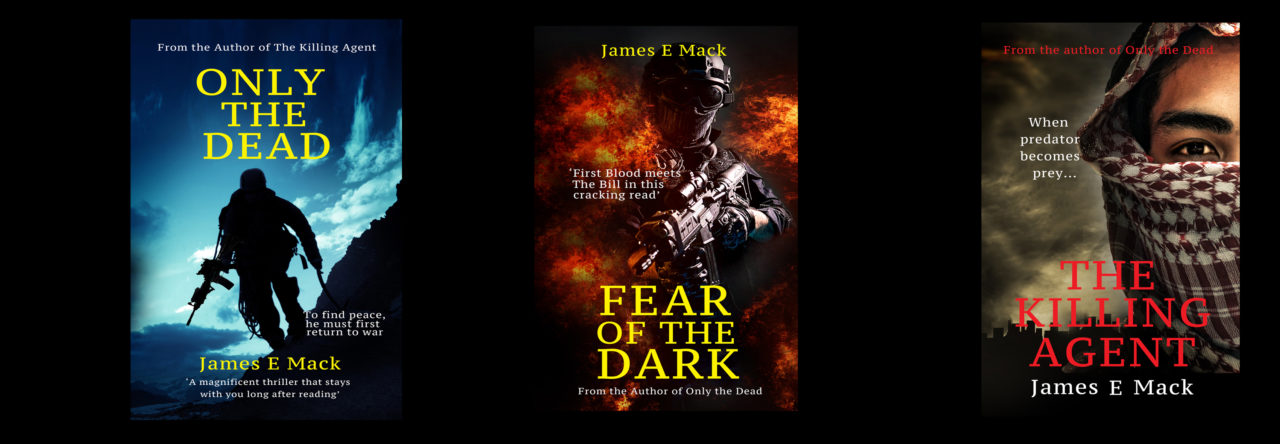
Kindle and Paperback together at last!

After a wee snag regarding title formats that didn’t match exactly, both formats of the book are now linked together on Amazon. Have to say, all engagement I have had with Amazon throughout this process has been very positive and responsive, very pleased!

https://www.amazon.co.uk/Only-Dead-James-Mack-ebook/dp/B072N8R8XK/ref=cm_rdp_product_img


Paperback on sale now!

Amazing to see the final piece of the puzzle done as my paperback version goes on sale with Amazon today!

Book Launch

A wonderful evening that brought together all the people who have supported me throughout. Lots of laughs and tremendous company!

The stunning table set for canapés and coffees, courtesy of Teresa Coull Events. The whole evening was a hit thanks to the planning and organisation and beautiful touches like this.


The obligatory speech, giving a little bit of background as to how the book came about.


The book and gift bags for guests.

Getting Closer…

Advance copies for reviewers arrived and very excited. Already have a really good review from a fellow author that a publication is looking to include if they have the available space.

Only The Dead

Got my Author’s proof today and, obviously, very excited. To hold an actual copy of my book in my hand is a tremendous feeling of accomplishment. The reviews from the advance copies I sent out are coming in and they will replace the holding text on the dust jacket/cover.

So…not long now. Launch date will be confirmed and pre-orders available.


Best Wildlife Trip ever….so far!

I’ve spent a lot of time around wildlife. Probably started when I was growing up as a boy in Australia, wandering barefoot through scrub and bushland, catching all manner of lizards and snakes to observe and marvel over. Even back then as a skinny kid exploring the bush, I dreamed of going to Africa and seeing lions, elephants and rhinos in the wild. Which I’ve done on several occasions now, but with this trip, I got up close and personal to the very animals I’d dreamed of seeing over the years.

Timbavati game reserve, Kruger National Park, South Africa. With the customary 0430 start looming, I woke ten minutes early, walked out on the verandah to the outdoor shower and made eye contact with a rather testy waterbuck with a set of horns only slightly smaller than me! In unspoken mutual agreement we gave each other a nod and turned back to going about our own business. Dawn had yet to break and some of the stars were still visible as night retreated, the Southern Cross sinking beyond the horizon. A naked, outdoor shower, pre-dawn in the South African bush. Already an amazing start to the day.

As a leopard had taken to sleeping under our accommodation, it was a wary walk to the transport,eyes peeled for our so far unseen, feline companion. The idling of the vehicles’ engines and the soft conversations of the trackers joined the awakening birdsong. A few quick gulps of steaming coffee and a shiver in the cool of the morning air and we drove off into the bush, the breeze cold against our skin.

The tracker turned to me and smiled, teeth gleaming beneath the shadow of his bush hat. “Today will be a good day again. Lions are moving through this area.”

This was welcome news and I checked the camera’s settings, ensuring it was ready for immediate deployment. I’d been caught out before; whipped the camera to my eye to catch one of those never to be repeated moments only to find out I’d left it on the previous night’s settings for star trails. Lesson learned.

Dawn’s rays crept over the eastern horizon as we entered acacia groves, the vehicle slowing to walking speed to avoid us having freshly-whipped faces to return back to camp with. And all the time accompanied by that heady tang of the bush; an indefinable smell, acrid yet sweet at the same time. Unmistakeable.

A muted cackle on the radio and tracker and guide huddled together, quiet voices unable to disguise their excitement. The tracker looked back. “Very close. We’ll move on a little bit and wait. I think I know where they are going.” This statement impresses some of us. He knows where the lion is going? Our vehicle creeps forward and pulls out into a small clearing ringed by low trees and thick bushes. Although not full daylight, our eyes have adjusted and it seems so to us. I watch the bush beyond our vehicle, scanning the foliage slowly and methodically, knowing from experience how difficult it is to spot wild animals in their environment.

I stop. Hold my breath and look harder into a small thicket. Something moved. And again, the faintest of colour shifts within the shadows under the canopy. A grey-coloured shape disappearing between gnarled, shrunken trunks and twisted roots. I motion with my hand towards the area and the tracker follows my indication and nods, giving me a thumbs-up. Still following the movement with my eyes I wonder what I am looking at. At this point it is still just a shape. Too quiet to be buffalo, not right for a waterbuck, too small for an elephant, definitely not a rhino. And then it was there. In the open of the clearing no more than ten feet from where I sat. A stunning young lion.

Sauntered? Swaggered? Very difficult to put a name to how a lion makes its way through its territory. Utter assuredness of its place is certainly the impression I got watching him cross the small clearing, a casual glance towards us and instant dismissal of our importance to him. Just as he was almost half way across the open ground, another lion appeared from the undergrowth. Very similar in size, mane and attitude. The tracker whispers over his shoulder to us. “Brothers. Came over from Kruger this morning. They had a buffalo kill last night so they’re looking for water now.”

My camera was up and I focussed the long lens, getting detailed shots of these magnificent creatures. If you’ve ever seen a lion in a zoo or safari park, they are generally pretty plump, sedentary beasts with an air of resignation at their lot in life. These animals were a world apart. Lean and muscular, cords and tendons visibly roiling beneath tight skin. Scars punctuated every area of their bodies. An occupational hazard when your evening meal can be anything up to half a ton of horns, hooves and teeth fighting for its survival.

The brothers melted into the scrub beyond the clearing and the guide manoeuvred the vehicle and drove a short distance further. With no sign of the lions he parked alongside a small, muddy pool and turned the engine off. I quickly checked my shots on the LCD screen, that initial momentary fear that they would be out of focus or my ISO was too low. But no; I had some great images. Looking up, I watched as the brothers appeared on the bank of the pool and again, dismissed our relevance with a casual glance.

I locked my camera in on them as they made their way through the dried mud, the hexagonal platelets cracking under their massive pugs. I knew the shot that I wanted; both of them, drinking together, head and shoulders in frame. And there it was. I fired off a rapid series of shots, adjusting the framing occasionally on the off chance one angle might be better than another. Then I stopped and lowered my camera.

Because another thing I have learned through the years is that the camera can all too easily become the focus of your attention and that you miss a lot of what actually brought you here in the first place. The animals. That privilege of proximity to apex predators in their environment. That primal excitement when the lion’s deep, sawing roar reverberates through your own chest.

I watched them until they’d drank their fill and moved off, their backs turned towards us, tails twitching at the flies buzzing their rumps. As they entered the forest and left us for good, I thought about what we had witnessed and how lucky I felt to be present at such a sight. Even though I’d encountered leopard, elephant, rhino and buffalo on this trip, there was something very special about the fraternal aspect of this morning’s activity.

An incredible experience and a true privilege to have had on the last morning of our trip.

Page 6 of 7

Powered by WordPress & Theme by Anders Norén