
Available now in Kindle and Paperback Formats.
https://www.amazon.co.uk/dp/B07DK976FZ/ref=tmm_kin_swatch_0?_encoding=UTF8&qid=1528312442&sr=1-2
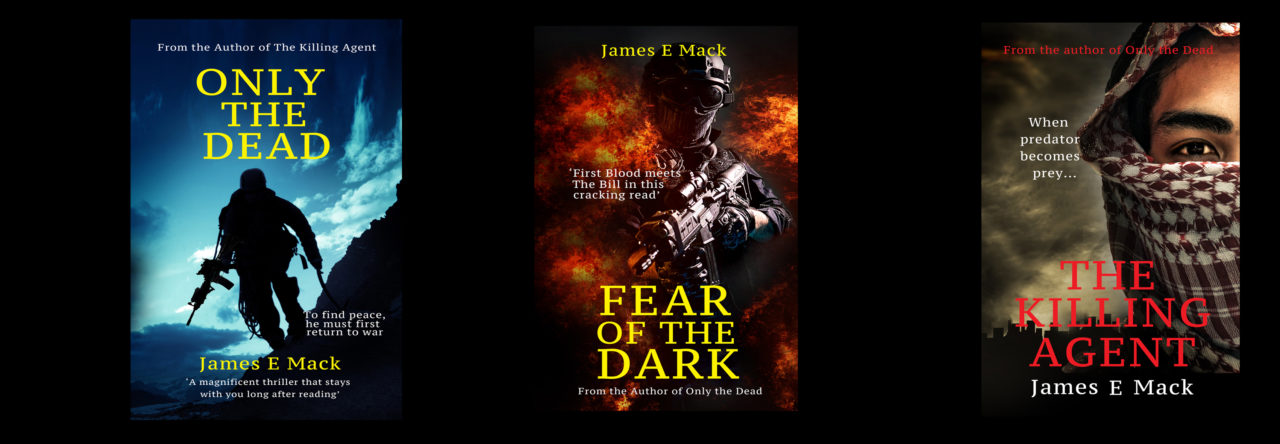
Available now in Kindle and Paperback Formats.
https://www.amazon.co.uk/dp/B07DK976FZ/ref=tmm_kin_swatch_0?_encoding=UTF8&qid=1528312442&sr=1-2

Initial cover for my latest novel. Looking good and happy with the overall effect. Different from Only the Dead in that this book centres around a small team of rural Police Officers thrust into a life and death situation while completely cut off.
Similar themes of PTSD and maladjusted, former Special Forces soldiers remain but have maintained my character-driven form for the premise of the novel.
Have also leapt upon one of the comments from my review team who coined the phrase ‘First Blood meets The Bill in this cracking read.’
That’ll do for me!


The conflict in Northern Ireland was referred to as ‘the Dirty War’ by many of us who served there, both because of the way it was fought and the appalling impact it had upon the victims.
The Good Friday Agreement was presented to the public as the panacea that would bring the violence to an end once and for all. It was an extremely bitter pill to swallow for the relatives of those who had died at the hands of the paramilitaries over the years and had then had to watch these murderers return to their communities feted as heroes.
It was also a bitter pill for the Security Forces and the Intelligence Services to digest, reflecting on the risks and toil over the years it had taken to put these killers where they belonged in the first place.
Too much was asked of our soldiers when operating in Northern Ireland:
The republican PR machine, with its backers and sympathisers from the UK and the USA, was very effective in portraying British soldiers as murderers carrying out a state-sponsored ‘shoot to kill’ policy. The real truth is that soldiers in Northern Ireland actually dreaded the day when they would have to use their firearm because they knew too well the legal consequences of the action and the pressure that the republican movement would heap upon the Government for punitive measures to be taken against the individual.
An example which I believe typifies this is the horrific killing of Army Corporals Derek Wood and David Howes. These two soldiers were murdered in the most brutal manner by a mob of republicans, all recorded by a helicopter’s camera from above. The point here is that both men were armed but the only shot that was fired was fired into the air to attempt to get the mob to retreat. The majority of soldiers who watched the incident unfold or saw it on later coverage were puzzled as to why the men never fired at their attackers. It is my firm belief that, like most soldiers of that era, they had been so used to following the wisdom of never firing your weapon that when the time came when it was absolutely necessary, the mindset just wasn’t there.
We have entered an era where we seem very keen to illuminate the actions of our past with the enlightenment of today’s knowledge, statutes and protocols which have no comparison to the muddled mission statements and directives that soldiers followed through the years of the the Troubles.
Under the GFA, the paramilitary murderers and criminals returned to their families and friends. Those who were On The Run from the law were issued official letters confirming that they could also return with no threat of incarceration hanging over them. Yet we now find we have a government in power who want to pursue former soldiers, some of them well into their 60’s and beyond, for mistakes made while carrying out the country’s domestic security policy? I thought I’d seen it all with the Phil Shiner affair but clearly not.
Don’t hound these veterans for the actions carried out decades before under the most difficult of circumstances. Don’t judge their historic actions using today’s comparisons. Don’t pretend there is anything to be gained other than to pander to the republican victimhood agenda.
But if the government is determined to follow this course of action, then every minister, policy writer and senior MoD official linked to the formulation of policy for military operations during this period should also be held under the same scrutiny. Deployed Service personnel are merely a physical representation of a government’s domestic or foreign policies; nothing more.
Here’s an idea: Level the playing field. Give our NI veterans a ‘Good Saturday Agreement’. Acknowledge that mistakes were made while operating under stressful conditions with muddled directives and policies. Acknowledge that no party with any involvement in the Northern Ireland conflict will ever be satisfied and therefore also acknowledge the futility in highlighting one party, the veterans, for investigation.
Give the veterans their own official letters, letting them know they have nothing to fear from legal reprisals. Allow them to remain at ease in their homes with their families. In short, allow them nothing more than that which was afforded to the terrorists and criminals who dragged Northern Ireland through a senseless conflict for over three decades.


It may seem an odd title for a post regarding the Russian poisoning of Sergei Skripal in Salisbury but bear with me, as I’m hoping it will make sense.
I, like many of my generation, have struggled to understand the rising popularity of Jeremy Corbyn as a future leader of the United Kingdom. However, I have no axe to grind with those who support him as I believe that the individual votes for the candidate that they believe represents their views and positions the best. And it would be nothing short of arrogant of me to shout them down by implying that I am fully cognisant of their entire personal circumstances.
As I say though, I am pretty sure that it is a generational issue. I am of an age when I remember Corbyn’s unflinching support for the IRA, attending terrorist’s funerals and standing shoulder to shoulder with the very people who were bombing London, Manchester, Warrington and other UK cities and killing innocents as they went about their daily lives. I remember well his support for communist and left-wing regimes that sanctioned and conducted state-sponsored murder and executions of any opposition, real or imagined. Jeremy Corbyn seemed, to me at least, to hate the UK so much that he would leap at the first opportunity to embrace any cause that ran contrary to our national interests.
But that was all happening as I was growing up. Corbyn’s bedrock of support is sustained in no small part by the younger demographic. And the younger demographic will always seek to go against the trends and values of their previous generation as they always have. This is human nature and something we do almost without thinking. More significantly though is the fact that the younger generation who are championing Corbyn et al, grew to maturity in a very different time than people of my age.
Consider it for a moment: They grew up when the IRA were on a ceasefire and had signed up to the Good Friday Agreement. Not for them the daily grind of grim news reports of sectarian murders and bombs on British streets. They grew up after the Berlin Wall had been torn down. No sitting open-mouthed in front of the television watching as a couple were mown down by machine gun fire as they ran the gauntlet of razor-wire entanglements to reach the West. Yes, we have the dread of Islamic fundamentalist attacks as a feature in today’s society but these are franchised actions with amorphous links and relations to an ideology rather than an actual physical entity.
In short, they grew up without their country experiencing a definitive threat. They grew up without any exposure to an actual enemy. Because that is what both Russia and the IRA were to the UK; our enemies. That word sounds almost anachronistic even as I write it. A term discarded long ago as we seek to convince ourselves that in our new enlightened age there can be no such thing as enemies, that somehow any conflict or aggression can be solved with dialogue and political detente.
Which is great if the whole world follows this ethos. But of course, they don’t. But what they do, is exploit the good intentions and soft-skills approach to their own advantage. Russia has used our 16-year distraction in Afghanistan to develop and hone their asymmetric conflict tactics to great effect. Their mastery of information operations to subvert and sabotage smaller states and countries is actually well-ahead of most nations. We just need to look at Georgia and the Ukraine as past examples and the Baltic states as current ones where the Bear’s malign influence is being wielded.
And now we have the Labour leader in the UK categorically refusing to support the call for punitive measures against the country that has, to all intents and purposes, committed an act in contravention to NATO Article 5; a state-sanctioned, armed attack on a member country. By Friday, he softened his tone somewhat by declaring that he was willing to accept the possibility that ‘McMafia’ type criminals may have been responsible. What is encouraging is the way his own backbenchers have distanced themselves from him and are openly giving their support to the PM in defiance of their leader’s directive.
Yet still, we have a significant amount of people who, like Jeremy Corbyn, are pushing out the narrative that this was nothing to do with the Russians and even worse, that our own intelligence agencies carried out the attack in order to whip up national fervour and support for…well, your guess is as good as mine.
But here’s the point; Russian info-ops count heavily on the acceptance and support for their narratives and the subsequent spread on social media. And those who, like Corbyn, utterly reject the facts in favour of half-baked conspiracy theories, are assisting the Russians. Jeremy Corbyn’s pantomime performances in Parliament over this issue are edited and re-broadcast in Russia where the population there is led to believe that he is the last bastion of truth in a corrupt and feeble UK government. And the message to the people is clear; the Russian government had nothing to do with this attack and even the UK’s most popular politician is saying this.
Vladimir Putin just won another election term based on no small part on his strong stance on the international stage. The Kremlin’s aggressive foreign policies distract from the everyday suffering of ordinary Russians under Putin’s leadership and the narrative very cleverly controlled by the state media outlets. There is no independent outlet to counter these messages or broadcast the truth. Instead they take well-edited snippets from people like Jeremy Corbyn and mesh these with their domestic reports to create the illusion of international suspicion that the UK carried out these attacks.
Even now, the UK has deployed thousands of Service personnel to the Baltic states to provide a show of force and a deterrent to Russia’s recent aggression. And the reports are already coming back of Russian info ops setting up off-duty soldiers in PR coups and stings that are then reported as criminal acts against the Russian populations within Latvia, Lithuania and Estonia. Russia had almost succeeded in portraying Latvia as a failed state, just as they had achieved with the Crimea. Their next phase was obviously a physical invasion of the small country disguised as a ‘defence intervention’ on behalf of persecuted Russian communities in Latvia. Our deployment alongside that of our allies has, if nothing else, put the brakes on the momentum for this invasion if nothing else. But for how long is really anybody’s guess at this stage.
So when I read of people, especially those who should know better, repeating the Russian narrative, I get pretty annoyed. They are falling for the political equivalent of the ‘Nigerian Millionaire-Prince Scam’. But the impact here is far greater than that of an idiot being relieved of some cash. It is assisting a hostile foreign power who are murdering people in our own country to get away with it.
I’m not advocating that we should never challenge our government or our Security and Intelligence Services. I actually believe that questioning and challenging are healthy accountability processes that encourages these agencies to be as transparent and compliant as possible. But there is a giant difference between questioning and challenging and championing the Russian narrative. And those who do this are sleeping; keeping their eyes and minds closed to facts and reality. Sleeping through scientific reports that name and date the source of the poison. Sleeping through the very strange deaths of other individuals who have escaped their Russian masters. Sleeping through the ill-concealed pride and glee that the Kremlin is reacting to the poisoning of Sergei Skripal and his daughter with.
But they are not just sleeping, as their actions have impact beyond themselves. Their sleeping through fact and reason gives strength to the Russian cause. To the enemy cause.
Sleeping with the enemy.

For anyone who has spent anytime in the service of their country, particularly in conflict zones, there will usually be specific songs or music that recall the experience or relate to it. When I was younger and began looking at joining up in a more serious light, I began watching the popular war movies of the day.
Generally speaking, I’d seen most of the WW2 classics that my father had been fond of when I was a kid, but very few of these had songs or memorable music. For me, it was the profusion of Vietnam films that first provided war and conflict with a soundtrack. Particularly when I was at the age where I was preparing to sign on the dotted line and had a renewed interest in all things military.
On the eve of heading down to Lympstone to attend the Potential Recruit’s Course, my friend and I watched Full Metal Jacket. I still rate it as a superb piece of work but taking the cinematic accomplishments aside, it was also one of the first war movies where I really paid attention to the music. I noticed that the music that accompanied the scenes added something different compared to other movies I’d seen. Nancy Sinatra’s ‘These boots are made for walking’ played over the scene of a Vietnamese prostitute approaching the soldiers as they are robbed by locals on a moped. Or The Trashmen’s ‘Surfin’ Bird’, played on a radio in the background and then as part of the soundtrack proper as the platoon are interviewed as they are deploying to Phu Bai.
The next major movie of note that I would have to say really utilised a soundtrack to augment the film was the classic Platoon, the big screen adaptation of Oliver North’s account of his experiences as a young grunt thrown into the chaos of an ill-understood war fought by a largely conscripted army. The music used in Platoon was, in my opinion, the first time the significance of the soundtrack in augmenting a war movie was really put into effect. From Smokey Robinson’s ‘Tracks of my tears’ to the haunting ‘Adagio for strings’ that accompanies the scene where Sgt Elias is killed, the music was clearly well-thought out.
So, to that end, here are 10 songs relating to war and conflict that, over the years, I find myself being drawn back to again and again for either their impact or the memories that they invoke.

Copperhead Road by Steve Earle
I really can’t remember where I first heard this but it is a real favourite for me. Earle’s growling vocals and the mandolin riff that morphs into the signature blues-rock narrating the tale of a redneck boy and his journey from white trash to Vietnam vet to drug smuggler.
‘…now the DEA’s got a chopper in the air, I wake up screaming like I’m back over there,
I learned a thing or two from Charlie don’t you know, you better stay away from Copperhead Road…‘
https://www.youtube.com/watch?v=xvaEJzoaYZk

Soldier by Harvey Andrews (sometimes called A British Soldier)
Based upon the heroic actions of Sgt Willets of 3 Para in Northern Ireland in 1971, the folk-singer Harvey Andrews was so moved by Willets’ selfless bravery that he felt compelled to write a song that told the story of the soldier. The song is well-known by service personnel and held in high regard for both its poignancy and the rarity of recognition for the conditions that the forces endured during the Northern Ireland conflict.
‘…then came the call to Ireland as the call had come before, Another bloody chapter in an endless civil war,
the soldiers stood between them, between the whistling stones, and then the broken bottles that led to broken bones..’
https://www.youtube.com/watch?v=wKZQyv6X4JI

Khe Sanh by Cold Chisel
Almost something of an unofficial Australian anthem this is another cracker of a tune that grabs you right from the first line. The legacy of the Vietnam war on the veteran and his problems in coping with life on his return are laid bare through the gruff vocals and brilliant piano/guitar accompaniment.
‘…I left my heart to the sappers round Khe Sanh, And my soul was sold with my cigarettes to the black market man,
I’ve had Vietnam cold turkey, from the ocean to the silver city, and it’s only other vets could understand…‘
https://www.youtube.com/watch?v=dTjvG4WJD_A

Travelling Soldier by The Dixie Chicks
At the height of their popularity, The Dixie Chicks made a very public statement attacking the decision of the Bush administration to take their country to war again with Iraq. Their music was immediately boycotted by many radio stations in the US and with several major retail chains refusing to stock their music, their career tanked badly. From multi-million sales to a slack handful over the course of a year. They always insisted that they fully supported the US Military but took issue with the government’s foreign policy decision. They wrote Travelling Soldier as a rebuttal to the boycott and as a demonstration of their commitment to the US Armed Forces.
‘…so the letters came from an Army camp, in California then Vietnam, and he told her of his heart, it might be love and all of the things he was so scared of…
he said when it’s getting kind of rough over here, I think of that day sitting down at the pier, and I close my eyes and see your pretty smile, don’t worry but I won’t be able to write for a while…‘
https://www.youtube.com/watch?v=AbfgxznPmZM

When the Tigers broke free by Pink Floyd
An unusual one, but then nothing that Pink Floyd produced was ever going to be pedestrian. Roger Waters penned the song in commemoration of his father, Eric Fletcher Waters who was killed during the battle of Anzio in 1944. The song is a short but intense piece made all the more atmospheric by martial score and the backing vocals of choir.


‘…I can’t remember anything, can’t tell if this is true or dream, deep down inside I feel to scream, this terrible silence stops me,
Now that the war is through with me, I’m waking up, I cannot see that there’s not much left of me, nothing is real but pain now…’


I have a colleague who spent a full and busy career in the Police, operating at every level and all over the country but specialising in London and the South East of England. A large proportion of his work involved dealing with young gang members and the crimes they committed. He is adamant that a major part of the problem that fuels gang membership is the lack of credible male role models within these communities. It is this, he insists that pushes young individuals into the hands of the very people who will destroy any possibility of a normal life.
Our conversation got me thinking about role models throughout my own life and in particular, within my military career. My first exposure to individuals I sought to emulate and aspire to be like was on my Royal Marines’ Potential Recruits’ Course; the PRC. This was essentially a few days spent at the Commando Training Centre where the Royal Marines got to take a closer look at you while you got a small taster of what would be in store for you should you choose to accept it.
From the off I found the staff at Lympstone to be all manner of things: Funny, confident, sarcastic, brutally honest, to name a few. And this didn’t change when I began my training as a fledgling Commando recruit. Like most bootnecks, my first real exposure to any kind of role model was our DL, the man charged with getting our precious little backsides through the first two weeks of induction. Our DL was, and still is, a very funny guy but with, understandably, very high standards. In our first two weeks at Lympstone he was the person that we saw most of, the man who informed us that we did not even know how to wash ourselves properly so arranged a demonstration of an individual cleaning out his crevices in the communal shower so that was no excuse thereafter for being crabby. Recently I posted a picture a friend of mine taken on day one of Induction showing myself and another two recruits standing by the demonstration locker. Despite this photo being close to 30 years old, and the DL having who knows how many thousands of Nods pass through his clutches, our DL commented on one of the individuals’ heinous crime of hiding dirty dhobi in his locker. 30 years on. Legend…
I was also a bit of a favourite of our PTI. The club-swinger, for whatever reason, took a bit of a shine to me and would often engage in a bit of banter while I was hoovering in oxygen from every orifice during another ‘mild’ beasting. In return, I looked up to the guy, as may Nods do to their PTIs. However, there were quite a few occasions that myself and my fellow Nods were witness to that stayed with me throughout my career and encouraged me to be as honest and fair in my dealings with people as he had been with us.
The first instance that springs to mind was when my Troop had been allocated an orienteering exercise around Exmouth on a Saturday morning. We were all pretty happy with this as it was a welcome departure from being worked all day around camp. Our PTI couldn’t attend so another individual took his place. Once in Exmouth, we set off in our pairs and completed the course which was really designed more as a time filler than any serious test of ability. On our return to the transport however, the sullen-faced PTI informed us that our PTI would be disappointed to hear that we had been cheating on the exercise. As no more was said on the matter, we assumed it had been a joke.
It wasn’t. On Monday morning, our PTI assembled us on the Bottom Field and informed us of his humiliation at being told of our dishonesty. And that he was going to make sure we paid the price for it in order to learn that integrity is everything in the Royal Marines. Daily thrashings after phys became the norm and, while this was bad enough, the fact that we’d let him down was also weighing heavily on us. After one such hammering, we had a Troop meeting on the landing and with everyone swearing their honesty, concluded that none of us had cheated. As I said, it was a welcome time-filler and not a test, so there had been no motive to cheat in the first place. Also, as I was the club-swinger’s blue-eyed-boy, the decision was made that I should put our case to him.
To be clear, this is not something that a Royal Marine Recruit would usually do. The standard response is to shut up and take the punishment rather than risk further wrath and retribution. But we all felt that our PTI was a man of integrity and that he would at least give me a fair hearing. And he did just that. I marched over to the gym, my plimsoll-clad, left foot slapping the tarmac hard and my brain struggling to form a coherent sentence that would explain our position without calling a PTI a liar. Once I’d gotten through the three hallowed doors that gave entrance to the PTI’s inner sanctum, my PTI stood up and asked me what the hell I wanted. I don’t remember the words exactly but I do know they came out alright and also how the expression on his face changed as I stammered through.
‘Are you telling me that Corporal X is a liar? Are you truly standing before me and claiming that a Royal Marines’ Physical Training Instructor looked me in the eye and lied to me?’ I told him that we definitely were not calling Corporal X a liar, but that not one of the Troop had cheated. He was raging. His face had changed colour ad his dark eyes were boring into me. There was silence for a moment before he pointed at me and said, ‘Okay, you give me your word that none of the Troop cheated on that exercise.’ So I did. Because it was true. He nodded and told me to thin out and that he would deal with me later.
The next day we had a normal, if indeed there is any such thing, phys session in the gym. At the end of it as we covered down on our spots, our PTI stood us at ease and looked down at us from the dais. He beckoned to someone behind us and the sound of running feet echoed in the gym as he was joined by the PTI who had taken us on the orienteering ex. Our PTI then addressed us.
‘In the Royal Marines, integrity is everything. And that doesn’t matter whether you’re a Nod, a Corporal, a Sergeant or a Rupert. It’s what sets us apart gentlemen. Corporal X would now like to say something to you all.’ The other PTI raised his head for the first time and began by apologising for lying about our performance on the exercise. As our collective gobs dropped open, he went on to explain how he was going through a shitty divorce and had been hitting the drink hard and taking his misfortune out on Nods in general. He then asked us to not look upon him as a typical example of a Royal Marines’ NCO as he was not. We should look upon him as the opposite. He finished with another apology and looked up at our PTI who nodded his permission for his colleague to leave. Our PTI waited until he had left the gym before reiterating the torrid time that the other PTI was going through but that this did not excuse his actions. As gobsmacked as we were I can still recall the significance of our PTI’s actions in calling out a colleague on the basis of the word of a recruit. Incredible really, and I know a lot of people who, even if they had suspected the untruth, would have taken the easy road of thrashing the Nods anyway.
Throughout training, I witnessed another couple of episodes which, while not as intense as this, still demonstrated the strong moral compass with which our PTI held himself too. Our paths continued to cross throughout the years, in Northern Ireland, Iraq and Africa. He picked up a gallantry medal at some point but more recently was awarded the George Cross for outstanding bravery in rescuing civilians from a terrorist atrocity. I was not surprised to see this at all, having identified from as long ago as recruit training, that he was made of the ‘right stuff’ for want of a better phrase.
Like many former service men and women, I have been fortunate to have encountered some of the finest role models who have made the biggest impact upon me and, I believe, helped to mould the person that I am today. I have also, like many, met some Olympic-standard throbbers who actually contribute in their own way, sending a shudder down my spine and a vow to ‘never be like that guy…’
I think my Police colleague is right; when we don’t have a role model in our immediate circle of friends and family, we seek it elsewhere, be that in sport, popular culture, or a gang. I truly believe that I was fortunate in being exposed to a steady stream of positive role models throughout my military career but that it all started with stepping off the train at Lympstone Commando and through the gates of CTC.

I’m not really one for watching lots of television although I love good movies or a high-end box set. To that end, I do sometimes find myself behind the curve in recognising current popular culture personalities, media-led trends, and what’s hot and what’s not.
Recently though, my good lady introduced me to the delights of ‘I’m a celebrity, get me out of here’. Essentially it’s a show devoted to the collection and demeaning of C and D list individuals of ‘celebrity’ status, dumping them in an Australian rainforest and forcing them to endure unpleasant trials to earn food. Roman colosseum entertainment for the 21st Century masses.
Be that as it may, the one thing that I picked up on was how much these personalities missed their homes and loved ones, despite the fact that, currently at least, they are around the 14 day mark. A fortnight. Watching a recent episode where the celebs received emails from people at home, I was struck by how emotional they were. And it got me thinking about those members of the Armed Forces who, throughout their careers, will spend years away from their homes and families.
A friend of mine posted last year about how he was gutted to be missing his daughter’s seventh birthday and went on to say that he had only been home for three birthday’s throughout her life. He didn’t moan or gripe about it as he’s a thoroughly professional soldier and one who accepts full responsibility for his choice of career. It was more a case of surprise at how much he’d missed once he’d taken pause and added it all up.
Our country asks a lot, and is given much, from our men and women in the Armed Forces. A standard military operational tour today pretty much writes off the best part of a year for the deploying personnel. Between the progressive exercises, mission-specific training, and pre-deployment prep, the six-month operational tour generally equates to a good nine month’s plus of absence from routine life.
The improvement in communication helps to offset this a little. Face Time, Skype, WhatsApp, Instagram, email etc all facilitate connectivity between the deployed individual and their families. I was reminiscing with a colleague recently about the old days of stone-age communications and the severe limitations.
On a mountainside in Northern Iraq my fellow commandos and I spent two months living in shell-scrapes under our ponchos. We would receive letters from home maybe once a fortnight if a helicopter was heading our way and if the mail had reached our headquarters element. We would go some weeks with no contact whatsoever with home and then receive a bundle of letters that had accumulated in a post room at a US base in Turkey.
The issue here was that it would take a long time for letters to make it between correspondents and many of us could be seen shaking our heads as we read the familiar line from our loved ones; ‘…why aren’t you replying to my letters?’ Or, my personal favourite was when the chopper would come in, land, be unloaded and the excited shout of ‘Mail!’ sent the troop running to the HLS. Someone would hand out the mail, yelling names and sarcastic remarks as they distributed the small white rectangles of morale. There was general quiet as each of us lost themselves in their missives but then there would be a yell of disgust or disbelief as one of the guys received a Poll Tax demand or a letter from his bank demanding he explain why he was consistently overdrawn. Perfect pick-me-up when you’ve been over a month with no other contact from home…
An attempt to alleviate this was the use of the ship to shore call using our radio equipment to call a Royal Navy ship that would then relay it to our loved one’s landline. Again, it seems surreal in this day and age to imagine sitting in a signaller’s tent talking into the handset of the largest PRC radio and trying to get it through to your loved one that she had to say ‘Over’ when she had finished her sentence, made all the more difficult by the five second delay. Or when you’d made the trek to the sigs location, waited for over an hour in the queue and then get nobody home.
Generally speaking, most Service personnel on operational tours are very busy so the time on the ground goes quickly for them. It is however, usually dangerous, stressful, and intense. Draw these elements out over six to nine months and it is not difficult to see how the UK military has become as exhausted as it has over the past ten years. A study I saw some years back showed that the same 35% of the military carried out 90% of the operational tasks, something I’d always suspected but was not surprised to see confirmed.
Year on year, the accumulation of absence from the routine of home life takes its toll. The missed Christmases, birthdays, anniversaries, concerts, New Year parties.
I’ve seen first hand the pressures that these extended absences from home have on the stability of the family unit. Many Armed Forces’ families often find themselves posted alongside their spouses to unfamiliar towns and cities. New schools for the children, new jobs, new routines and dynamics. When the Service member is deployed at this point, the wife or husband remaining behind is suddenly expected to cope with the responsibility of assimilating the family into their new life and deal with all the associated stresses.
When these deployments extend over Christmas, it provides an added pressure, particularly when there are younger children involved. I’m sure many of us have experienced seeing a friend or colleague looking a bit teary-eyed as they hang up the phone or log-off the computer on Christmas day before heading back to their Ops Room or sangar duty.
And the military does try to alleviate this for their deployed personnel. EFI-sourced entertainers, Charlie-Charlie messages from the CO, and the standard Christmas dinner for the troops are just some of the methods with which the pain of absence was supposedly alleviated. But, as someone else once said, ‘the more they try to make it like home, the worse it feels’, or words to that effect.
I’ve spent a lot of Christmases being away from home and usually in pretty grim places, sharing cramped accommodation or a basic bunk. It was always a little easier for me as I didn’t have children but still a lot for my partner to put up with. And sometimes I’d question it: WTF am I doing spending another Christmas day in a dusty, desert shit hole when I could be at home with a belly full of turkey and a large Laphroaig in my hand? Why does anyone do it?
We do it, or did it, because we serve. Because we chose to invest ourselves in something that required bigger sacrifices than could ever be expected of the standard Joe Public. And I think it’s sad to see that this notion of service is all but disappearing from our national psyche. More and more, people seem to be increasingly driven by the notion of self and individual gain than by the giving of anything back.
Even our government recognises this. David Cameron’s ill-fated initiative of a national service for the civilian sector, an indicator of his feelings on the subject. The fact that this initiative failed as spectacularly as it did shows I think, the level of public apathy for anything that does not provide personal gain or instant gratification. I also think that the further a nation removes itself from embracing the notion of service, the bigger the gulf between the people and the Armed Forces becomes, as the general populace have even less in common with the service men and women who deploy on their behalf.
So, to all those members of the Armed Forces deployed abroad this Christmas, or even stuck on Base Company duties or Unit Security, I say thank you. To the soldier carrying out framework patrols around a FOB, to the sailor safeguarding our maritime interests and to the Airmen and women posted to middle-eastern bases supporting our extended operations, thank you for your service. At a time when it can often seem that the notion of Service is all but consigned to the dustbin of history, you can be assured that many of us still recognise the value and importance of your sacrifices at this time of year.
So again, to those who serve, or have served, thank you. Thank you for your Service.

At this time of year our country comes together to support the Royal British Legion’s Poppy Appeal campaign. No change there. This year however, there was a very public challenge from another group championing the sale and purchasing of white poppies.
I’m not going to give a detailed history of the story of the Poppy Appeal, anyone interested can access this information from a quick type of the subject into a search engine of your own choice. To summarise though, the idea of the Poppy appeal was born in the bloodbath of Flanders’ Fields in the First World War and the subsequent poem by Lt Col John McRae. In 1921 the RBL organised the purchase of 9 million silk poppies and sold them to raise money for returning WW1 veterans struggling with employment and housing issues. Subsequently a poppy factory was set up and employed disabled and disfigured ex-servicemen.
At no point was the message behind the campaign one of celebration or even commemoration of war. It was an altruistic initiative aimed at alleviating the suffering of men who had suffered the very torments of hell already.
What we have this year is almost a protest campaign by the white poppy supporters of the Peace Pledge Union. The white poppy too, has a long history, having begun to be promoted in 1926 for people to show their support to the ending of wars. They claim that their campaign is to support all the victims of all the wars. They believe that they stand as a group to promote the ending of warfare however it is the former element that brings them a lot of negative publicity.
During an uncomfortable chat show interview, Symon Hill of the Peace Pledge Union was put on the spot when he had to declare with a direct answer whether his organisation’s stance recognised members and supporters of ISIS. Citing the party line that his organisation could not pick and choose which victims of which wars, I’m pretty sure that he wasn’t prepared for the vehemence of the public response to his comments. Which surely is only to be expected when you are saying that you recognise people whose sole reason for existence is to kill anyone who disagrees with their philosophies and refuses to convert to their ideology.
I don’t have an issue with the Peace Pledge Union’s ethos of a war-free world and remembering victims of warfare. My issue lies with the poisonous narrative that is being spread about the origins and values of the Red Poppy campaign. I have watched as many people have swallowed the rhetoric spouted against the RBL’s ongoing efforts: That the Red Poppy is a celebration of war, that it is a commemoration of bloodshed, that it is a symbol of racism to wear one.
This is what makes the blood boil. Utterly untrue smears trotted out as facts by those perpetuating these myths. The PPU was also lambasted when it was discovered that they had exhibited at the National Union of Teachers’ conference to promote their campaign in an effort to being granted access to schools. It worked: The PPU signed up over 100 teachers to their initiative and this enabled them to have their £60 school education packs put into state schools throughout the UK.
Col Richard Kemp took umbrage with this initiative, highlighting the fact that taxpayers’ money should not be spent on indoctrinating children with a left-wing political agenda. The PPU counter that the Armed Forces are allowed to enter schools and talk to those of school-leaving age about life in the military and that therefore, the PPU should be allowed to counter this initiative by educating the same children with an alternative narrative. Even their language betrays the scorn and outdated, left-wing views that they hold about the Armed Forces.
The Armed Forces are part of the state’s infrastructure for the defence and security of the realm. They are essential to this and it is important that both recruitment and retention continue to be developed. Contrary to the PPU’s assertion, the Armed Forces offers some outstanding career paths for those who perhaps would be limited in their choices in a conventional environment. I certainly count myself as being included in this bracket.
I remember a conversation a couple of years back with a supporter of the PPU making the point that the Red Poppy and Remembrance Day in general was nothing short of a glamorisation of war and they had made the decision to support neither. When I pointed out the origins of the Red Poppy and the reasons behind it, I was accused of being unable to be objective, having come from a background in the Armed Forces. When I pointed out that actually, my first-hand experience in war zones had made me far more empathetic to the civilian victims than a casual observer of television reports, I was rounded upon and accused of being part of the war machine that caused the deaths in the first place.
Yes, part of the ‘war machine’: An evil conglomerate that deploys on a whim to murder, destroy and pillage small, defenceless nations cowering in fear. But what hit me more than anything else was this person’s absolute hatred for the Armed Forces and what they represented, and their apparent preference for a socialist/communist state that would address the situation. So I pointed out their lack of objectivity and congratulated them on their stubbornness for holding on to a discredited ideology that suppressed and massacred its own people as a means of controlling the masses.
The argument soon turned bitter to the point where my education was brought into question as some kind of justification as to why this person’s university-level education should add more weight to the discussion than my own. Despite the fact that their degree was in English Lit which, as far as I’m aware, doesn’t hold a significant element of geopolitics or social science modules…
I rarely lose my temper during debates or discussions with people like this, having learned many years ago that you can’t reason with morons. However on this occasion I was angry. This person was nothing less than ignorant, insulting, obnoxious, and unwilling to listen to any other viewpoint than that of their own. The irony being that these were all attributes that they levelled at members of the Armed Forces during our discussion.
So the angry me came out. But the good anger: That cold, controlled anger where you dominate the situation by projecting it through your demeanour, expressions, tone of voice, gestures. I delivered a monologue, punctuated by finger pointing and the ‘pusser’s hand’, on everything that the Red Poppy campaign stands for and destroyed every one of the individual’s misguided and misinformed opinions that they’d spouted as facts. I pulled their assertions apart and provided examples to highlight the erroneous beliefs. I could see the change in our dynamic with the person holding up their hands and nodding, leaning backwards, obviously feeling intimidated at my assertive stance.
When I had finished I asked them why they’d felt it acceptable to rant and rave at me with their insults and diatribe and how uncomfortable they’d felt when the behaviour was mirrored back at them. There was a lot of waffle at this point regarding their strongly-held beliefs and passions overriding manners and courtesy but I don’t believe this is the case.
I believe the problem is that their narrative, for the greater part, goes unchallenged or, at best, is given the minimum of rebuttal due in no small part to the vehemence with which they deliver their utter tripe. People being people, most probably walk away with a roll of the eyes or a slight shake of the head, ceding their corner in preference for the quiet life. Unfortunately this is interpreted as another victory and the moral high ground claimed with the flag of the misguided and misinformed, lending strength to their causes and campaigns.
So we should always challenge it. As I said at the start of this piece, I have no issue with the PPU’s aspiration for an end to all wars. I do take issue with their attempts to portray the Red Poppy campaign and Remembrance Sunday as things that they are not. I take issue with state schools spending taxpayers’ money on the white poppy educational packs. I take issue with the PPU’s loathing of the Armed Forces and its efforts to undermine recruitment among school-leavers.
But mostly I take issue with the fact that the PPU goes mostly unchallenged. The money raised by the sale of their poppies goes right back into their own coffers, not to any charitable cause or to aid civilian casualties. The RBL continues to this day to provide aid and assistance, through the revenue raised from the sale of the Red Poppies, to service men and women who desperately need their help. The irony is that it is this that is challenged by the PPU and its supporters and not the fact that funds raised by the PPU benefit no-one but their own organisation. And it is this that should be challenged, particularly at this time of year when we gather to remember the sacrifice that a nation made that allows the PPU and others of their ilk, the freedom of speech to deliver their misguided message.


In a very rare example of a politician raising their head above the parapet of conformity and non-confrontational policy statements, Rory Stewart, an MP, has called for returning ISIS members and supporters to be killed as traitors as a result of the threat that they pose to the United Kingdom’s national security. Mr Stewart, as well as being an MP for a seat in Cumbria, is also an International Development Minister for the FCO and DfID, and a former diplomat.

Such a bold, hard-line statement from any individual holding office is rare, particularly in the era of the career politician, whose mantra seems to be ‘if we do nothing, then we can do nothing wrong.’ But Mr Stewart is not a conventional politician by any measure. No stranger to the Middle East or the conflicts there, he also walked across Afghanistan in 2002, a remarkable feat captured in his book The Places in Between. What I enjoyed about the book was the fact that Mr Stewart did not fall for or espouse the usual guff about welcoming villagers giving him their last slivers of bread as befitted their customary obligations. Because he could speak the language (and because the majority assumption was that he couldn’t) Mr Stewart could hear first-hand the real conversations behind the duplicitous welcoming grins and invites. He did encounter some genuine hosts along the way, but I really respected his decision to balance his account with the reality on the ground so to speak.
Rory was also the youngest ever Chair of the Defence Select Committee and a Senior Coalition Official in Iraq in 2003 – 2004. It would be very easy for the liberal media to stamp on Mr Stewart’s comments as right-wing, hard-line and anti-islamic, as they tend to do. But it is a little difficult to do that with Mr Stewart as he is also the executive chairman of The Turquoise Mountain Foundation; a NGO charity aimed at reviving traditional arts and crafts and urban regeneration in Afghanistan. So; no muslim hater.
His comments regarding killing returning ISIS members and supporters stand out because of their complete transparency. There is no hidden message here. No softening up pre-statement for advisers to analyse the public response before moving forward. No. This was a clear statement with the justification included just in case there was any confusion.

Brett McGurk, the Special Presidential Envoy to Counter ISIS has made no bones about his aspiration and intention to kill all foreign ISIS fighters on the battlefield. This negates the requirement for messy legal quagmires and political hand-wringing over what stance to take on returning ISIS members. This solution would be the optimum one for all governments facing this quandary; ending the problem on the battlefield in the theatre of conflict. But not all will die there. In the UK, many have returned already, causing a nightmare scenario for our security and intelligence services.
With over 850 British citizens having fled to ISIS-controlled territories, around 150 having been killed and approximately 400 returning to the UK in the past 18 months (as of July 2017), it doesn’t take a mathematical genius to see that we have a significant problem. The Director General of MI5, Andrew Parker stated recently that MI5 is now foiling one major terrorist plot a month. The key word in this phrase is major; likely to result in significant loss of lives. This does not even take into account the hundreds of other plots in their infancy or struggling to get off the ground.

Add to this mix those returning ISIS personnel, dejected and defeated, the dream of the caliphate a hazy memory. Do we really believe that these individuals are going to reintegrate into normal society? Sit back on their sofas in Luton with a digestive and a cup of tea to watch Eastenders? Slot back into the Friday night treat of a KFC while watching TV in Kenilworth? Look back on their days in black as nothing more than a misguided gap year never to be repeated?

Max Hill QC, the Independent Reviewer of Terrorism, would appear to be of the opinion that yes, many of those returning from Iraq and Syria should be allowed to settle back into normal life. Should be given ‘space’ to readjust rather than being prosecuted. That they were ‘naive teenagers’ embarking upon a great adventure. Mr Hill’s comments are directly opposed to Rory Stewart’s and highlight the growing gulf in how our political masters will address the situation.
So, should we treat returning ISIS members and supporters as traitors, affording them the full measure of the state’s wrath? Or should we view them more in line with Mr Hill’s assessment?
I for one wholeheartedly subscribe to treating these returning dregs of humanity as traitors and I have several reasons for this:

And this is why I believe that these returning creatures have to be labelled, processed and tried as traitors. They are not returning because they realised the error of their ways, came to their senses and said ‘ ..mmm…these guys are mental, this is not for me.’ Maybe for the odd individual that could be the case but not for the majority. They are returning because the dream is over. The caliphate is gone and the black flack burned with its ashes scattered in the wind. These people are not returning to the UK to assimilate back into society and in any case, should not be allowed to do so. No matter how hard they try to assure the authorities otherwise, in some part of their psyche there lingers the motivation that prompted them to make the considerable effort to follow the black flag and cheer as men burned in cages.
And it is nearly impossible to redirect this motivation. But it is very easy to reignite it, blow on the hot embers until the flames are seen once again, rousing dormancy to a state of action. This cannot be allowed to happen. Rory Stewart completely understands this, probably as a result of his significant exposure to conflict zones and their associated issues. Max Hill does not.
Our government is charged with the duty of care of our nation and its citizens. When the head of MI5 is telling us that we have a real problem keeping a lid on terrorist attacks, what we cannot have is a returning population of individuals who hate our country, our people and our way of life. And who can slip back unnoticed into our general population where they can be the most effective to ISIS-sponsored plots and attacks.
Yes, it is a very hard decision for a government to publicly pronounce, particularly in this risk-averse climate the majority of our politicians seem to thrive upon. But it is a decision that cannot be shirked or prevaricated over. Send the clear message; a traitor to our country will be treated in accordance with the full wrath of the state. To do otherwise is a betrayal of the trust of the people who voted you into office and charged you with the duty of keeping us safe. More importantly, it is a betrayal to the families who have lost loved ones to the vile actions of these reprehensible criminals and their supporters.

While not entirely unique to the military, black humour is probably seen by commanders at every level as the key factor in assessing morale in trying conditions. A very true expression I came across time and time again in the military was ‘…don’t worry when your soldiers are complaining; it’s when they stop that you know there’s a real problem.’ And I found that to be very true; that no matter how bleak or tough the situation, the jokes and the banter kept coming. It was when this stopped that I knew we had something to worry about.
We use idioms and sayings such as ‘If you don’t laugh, you’ll cry’ that encapsulate the meaning of humour supporting triumph over adversity. I’m pretty sure every former and serving member of the Armed Forces has countless examples of these that they chuckle over whenever they recall them to memory. But they serve a very useful function whereby anyone who is feeling overwhelmed or scared shitless during a situation is brought out of their private hell by a shocking but hilarious statement. This pulls the individual back into the support of the group and takes their mind away from the deep, dark abyss it has just been peering over.
It also provides individuals with a relief outlet during times of extreme stress. An example of this I witnessed was when I had just rotated back to my unit after a stint in a very kinetic area of Iraq. We were on the ranges one day when the word came down that we had lost two members of our unit in an ambush. I didn’t know either individual other than on a casual basis but many others were shocked and devastated by the loss of close comrades. Saddled upon this sadness was the news that the roles of the recently deceased would have to be replaced.
Pretty much anyone who could have deployed had already done so, to the point where individuals were getting fatigued. But it’s the military and the show stops for no-one. Eventually when no volunteers came forward, a pressed man was found. He wasn’t happy about going back there so soon but accepted his lot with a healthy amount of cursing and complaining. But we knew this guy well and knew that he’d also had a close call on one of his last rotations. So…we are firing away on the range, enjoying the day and the rarity of the occasion when we could all meet up.
A colleague of mine mentioned how strained ‘Trev’ looked and I’d noticed the same thing myself. And we both knew he was processing his forthcoming deployment with anything but joy. Just then a military photographer arrived and said he’d been told to get a few pictures of us for the Unit’s historical archives. As we jostled for positions with the usual banter, ‘Trev’ remained off to one side, indicating that he wasn’t arsed about being in some crap photo for the CO’s study. There was a moment of quiet as everyone sympathised with what he was going through until my colleague stepped out of line and said ‘Oh come on Trev; this might be the last photo you’re ever in with both of your legs mate!’
The laughter was immediate, everyone creased up and even ‘Trev’ gave his first grin of the day and wandered over to join us. The comments were flying thick and fast with requests for his Breitling watch if he lost an arm and his Ducati motorbike if he didn’t make it back at all. He was laughing himself now and demonstrating his contempt for our lack of respect with his two upturned middle fingers. We turned our attention back to the photographer who was setting up his cameras and shaking his head. ‘There’s something seriously wrong with you lot.’ was all he said.
But he was wrong. If we’d all been of a mind to tiptoe around ‘Trev’s issue, or sympathised with well-meaning platitudes; the ‘You be careful over there’, ‘I can’t imagine what you’re going through’, ‘You must be so disappointed’ etc, etc, etc…it would have made matters worse. As it was, he left the ranges a different man from the morose scowler who’d started the day. Only problem was when he went back and was relaying the tale to his girlfriend that night, she didn’t quite see the funny side. Oh, and he returned to us six months later. With all his parts complete.
Even during the most extreme circumstances, black humour can act as a coping mechanism that enables individuals to get through the short term period of trauma or shock and allow them to carry on with the task at hand and deal with the emotions later when in a safer environment.
An officer that I knew visited the rehabilitation unit at Headley Court and had steeled himself for the sight of amputees and disfigured soldiers. He’d anticipated a morose, maudlin hospice where the feelings and sensitivities of the patients would require great care in order to avoid offence. To his relief and surprise, nothing could have been farther from the truth. What he encountered was an environment of tough-willed individuals who refused to be defined by their injuries and relentlessly mocked each other’s ailments and injuries.
He witnessed many occasions where, during the sports sessions, double amputees would mock those who had lost ‘only’ one leg, referring to them as ‘plastic’ or false claimants, showing off with their big, fat, white leg. On one occasion he was stood speaking to a wheelchair-bound veteran when another individual in a wheelchair negotiated past them. Without a word, this individual reached out and upended the veteran my friend was talking to, tipping him right out of his wheelchair and onto the floor. My friend was stunned as the perpetrator sped off down the corridor hooting with laughter. The guy on the ground looked up with a huge grin, shaking his head. ‘Bastard! He’s owed me that for ages since I loosened the wheels on his chair a couple of weeks ago!’
There was another interesting aside to the Headley Court example around a few months after this story. The comedian Jimmy Carr made a joke that went something like:
‘Isn’t it awful, all those poor soldiers coming back from Afghanistan. Wounded, maimed, losing their arms and legs. Absolutely terrible…but on the plus side, Great Britain is going have a good chance of winning the Paralympics next year!’
I found this funny. My friends found it funny. Some of the tabloids however went after Jimmy Carr with a vengeance and he was forced to make a public apology and retract his comment. A letter written by a group of injure veterans was put together and sent to the tabloids telling them not to try and speak for them when they were perfectly capable of voicing their own opinions. And that they had found Jimmy Carr’s joke hilarious.
Like many of us, I have retained my love of black humour but have also learned to be careful where and when I indulge in it. The world is littered with masses of individuals just waiting to take offence at the merest hint of an improper remark. A very good friend of mine relayed the story of a BBQ with his new colleagues from his office job shortly after leaving the forces.
They’d began telling funny stories and anecdotes and my friend joined in, throwing his hat in to the ring with a tale that involved a shooting, a brothel, the theft of a prosthetic leg, and a baboon. A classic saga of soldiers abroad getting into a ridiculous situation and living to tell the tale. It was his wife’s hissing of his name that alerted him to the fact that all was not well. It was one of his favourite stories from his time in the military and he’d gotten so caught up in the telling of it he’d failed to register the silence and shocked faces of his new co-workers. The awkward silence that followed underlined how unimpressed his colleagues were with the dark, funny story. But he remembered the laughs he’d got relaying the same tale in his previous life and thought he would receive the same reception from his new co-workers. Sadly, this was not the case.
Paramedics, Fire and Police Service personnel also share a healthy black humour that again, acts as a coping mechanism for dealing with the grim nature of some of their roles. And while it can be frowned upon by officious jobsworths with little else to occupy their time, I for one will never lose my regard for the value that it serves.
Powered by WordPress & Theme by Anders Norén